
The Importance of the Dojo: Why Your Training Environment Influences Your Growth
The Dojo is much more than just a gym. Understand how the philosophy and atmosphere of this sacred space accelerate your Karate learning and shape your character.

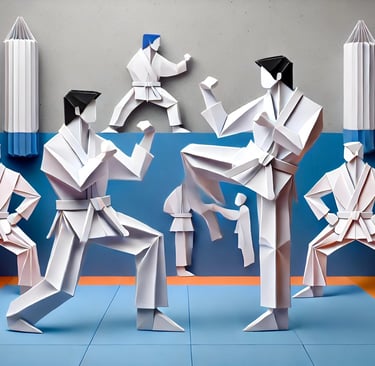
For those unfamiliar with martial arts, the word Dojo might seem like just a Japanese synonym for "gym." However, for a karate-ka, this translation is incomplete. Etymologically, Dojo means "The Place of the Way" (Do = way; Jo = place). It is a space dedicated not only to physical exercise but to the pursuit of self-perfection.
The difference between training in a Dojo and working out in a standard fitness center is profound. A Dojo's environment is designed to influence your mental state, your discipline, and, consequently, the speed of your technical progress. When you cross the threshold, you leave the outside world behind to focus on a single thing: your transformation.
The Dojo as a Sacred Space
Unlike other sports facilities, the Dojo is governed by a set of etiquette and respect rules that elevate it to a near-sacred status. The silence, the bowing upon entering and exiting (Rei), and the rigorous organization are not mere formalities. They serve to condition the mind.
By entering an environment where respect is the foundation of all interactions, your mind understands that this is a place of focus. There are no distractions like cell phones, side conversations, or loud music. This "isolation" from daily chaos allows the practitioner to reach a state of concentration rarely achieved elsewhere. It is in this state of absolute presence that true Karate training happens.
The Influence of Collective Energy and Hierarchy
One of the factors that most drives evolution in Karate is the community of training partners. In the Dojo, there is a clear hierarchy between senior students (Senpais) and junior students (Kohais).
The Role of Senpais: Seeing a higher-ranking student execute a technique perfectly serves as fuel for the beginner. Visual example is one of the most potent teaching methods in martial arts.
The Responsibility of Rank: For veterans, training alongside beginners reinforces patience and humility, demanding that their own technique be flawless to serve as a model.
This collective energy—or egregore—creates a sense of mutual responsibility. When you train in a serious Dojo, you don't want to give up—not just for yourself, but out of respect for your teacher (Sensei) and your partners who are pushing themselves right beside you.
A "Mirror" for Character
It is said in Karate that the Dojo is a mirror. In the heat of training, when fatigue sets in and the technique feels difficult, your true personality emerges. Are you the type to quit when it gets tough? Do you get angry when you can't get a movement right? Or do you stay calm and try again?
The controlled environment of the Dojo allows you to face these weaknesses in a safe place. The Sensei observes not just your kicks, but how you react to hardship. This constant correction of attitude inside the Dojo is what prepares the student to face life's problems with much more resilience. Without the correct Dojo atmosphere, Karate would risk becoming just a combat technique void of values.
Physical Structure and Discipline
Even physical details influence your progress. The tatami mats, the walls often decorated with the Dojo-kun (the precepts of Karate), and the absence of mirrors in some traditional styles all serve a purpose. Without mirrors, for instance, the student is forced to develop proprioception—the ability to feel one’s own body in space—rather than simply relying on their reflection.
Maintaining the Dojo is also part of the training. In many schools, students help clean the space (the ritual of Soji). This teaches the release of ego and care for the environment that welcomes us, reinforcing that Karate is a two-way street between the practitioner and the world around them.
The Dojo is the cradle where the karate-ka is born and developed. It is the safe harbor where mistakes are allowed so that success can be built. Understanding the importance of this environment is what separates a student of martial arts from a true martial artist.
Contact
contato@haikaratedo.com