Shotokan vs. Goju-Ryu: Understanding the Main Karate Styles
Understand the technical and philosophical differences between Shotokan and Goju-Ryu. Discover which of these great Karate schools best fits your profile and goals.
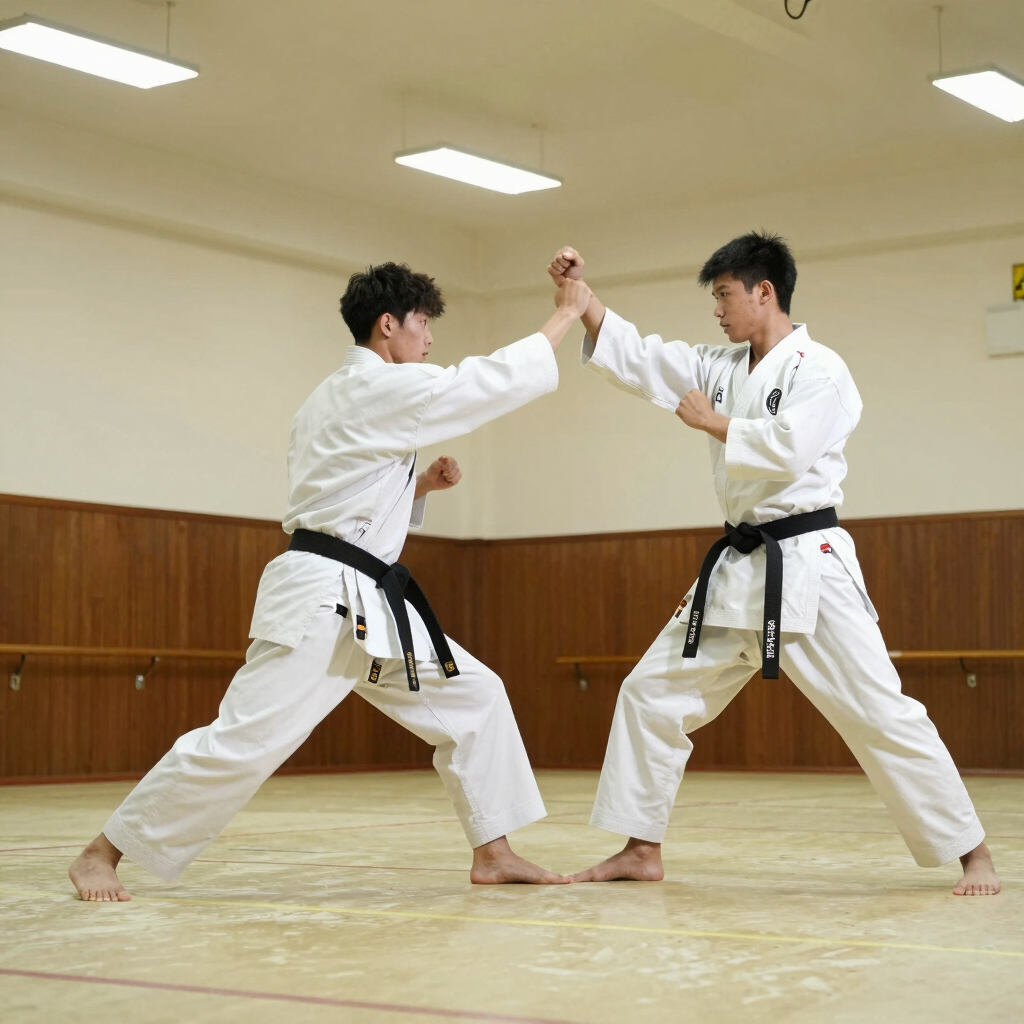
If you walk into two different dojos, you might feel like you are seeing distinct martial arts. In one, students perform long stances, rectilinear movements, and maintain considerable distance. In the other, movements are circular, breathing is audible, and combat happens almost "hand-to-hand." These are the faces of Shotokan and Goju-Ryu, the two most practiced Karate styles on the planet.
While both share the same Okinawan origins and seek to perfect character, the "way" to get there varies. Choosing between one style and another depends heavily on how you prefer to use your body and which combat philosophy makes the most sense to you.
Shotokan Karate: The Power of Linearity and Distance
Founded by Master Gichin Funakoshi, Shotokan is often the first style people encounter. It is visually striking, characterized by very low stances and long-reaching movements.
Technical Characteristics: Shotokan prioritizes Sun-dome (control of the strike before impact) and long-range combat. Practitioners seek to hit the target with maximum speed and power through linear movements.
The "One Strike" Philosophy: Here, the concept of Ikken Hisatsu (one strike, one victory) is taken to its peak. The goal is to end the confrontation before the opponent can close the distance.
Did you know that the low stances in Shotokan aren't just for "tiring your legs," but for creating a center of gravity so stable that every punch carries your entire body weight? If you enjoy athletic movements, geometric precision, and a sport-oriented approach (as Shotokan dominates WKF competitions), this might be your path.
Goju-Ryu Karate: The Balance Between Hard and Soft
Founded by Chojun Miyagi, Goju-Ryu maintains strong roots in Chinese martial arts. The name itself says it all: Go (Hard) and Ju (Soft).
Technical Characteristics: Unlike Shotokan, Goju-Ryu focuses on close-range combat. Stances are higher and more natural (like Sanchin Dachi), allowing for greater mobility in tight spaces. Blocks are often circular, designed to deflect an opponent's force rather than collide with it.
The Power of Breath: A pillar of Goju-Ryu is Ibuki breathing. This is a deep, audible abdominal breath that strengthens the core and stabilizes the body at the moment of impact.
Have you noticed how, in a real self-defense situation, space is usually limited? Goju-Ryu specializes exactly in that. It utilizes grappling, joint locks, and strikes to vital points that are extremely effective at short distances. If you seek an art that joins physical resilience with the fluidity of water, Goju-Ryu might be your ideal choice.
Key Differences: Which One Suits You?
To make your choice or understanding easier, let's compare the central points:
Distance: Shotokan "hunts" the opponent from afar; Goju-Ryu waits for the opponent to enter its zone of control.
Movement: Shotokan is linear and explosive; Goju-Ryu is circular and continuous.
Katas: Shotokan katas are broad and fast, focusing on performance and power. Goju-Ryu katas are dense and focused on breathing, lacking internal strengthening.
Have you ever wondered if you prefer to be like lightning, striking quickly and retreating, or like a rock in the middle of the ocean, withstanding the waves and repelling them with the same force? There is no right answer, only the answer that best suits what you seek as a martial artist.
Conclusion: Different Branches of the Same Tree
Despite the aesthetic differences, both styles teach the same values of respect, discipline, and self-confidence. A Shotokan master and a Goju-Ryu master will reach the same conclusion about what Karate is: a tool to become a better person.
Many practitioners, after years of training, eventually study elements of the other style to make their Karate more complete. The Shotokan practitioner learns the softness of Goju-Ryu, and the Goju-Ryu practitioner learns the explosiveness of Shotokan.
Contact
contato@haikaratedo.com