Martial Etiquette: Why Do We Bow (Rei) in Karate?
Understand the meaning of the greeting in Karate. Discover why "Rei" (the bow) is the foundation of respect, discipline, and safety both inside and outside the dojo.
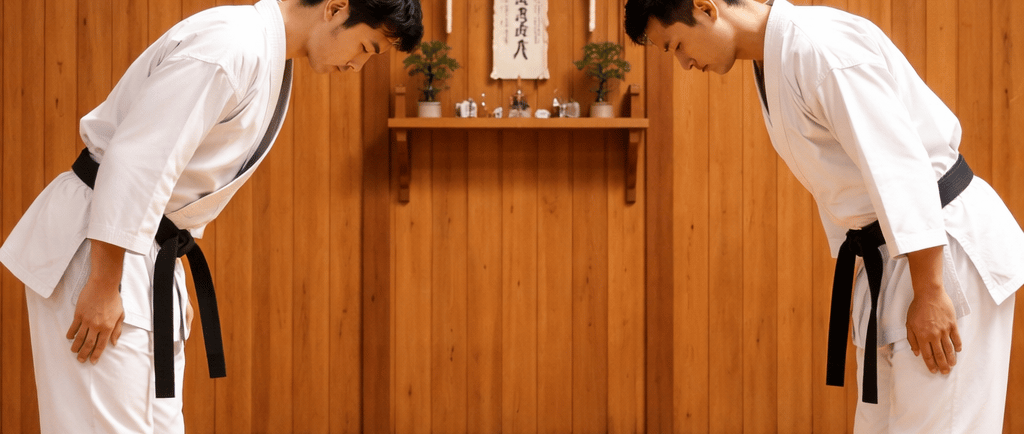
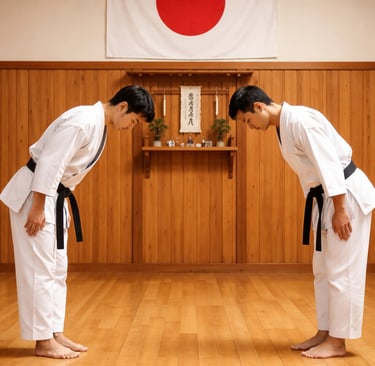
If there is one phrase that defines traditional Karate, it is from Master Gichin Funakoshi: "Karate begins and ends with respect." In the dojo, this respect is physically manifested through Rei, the bow. To an untrained observer, it may look like mere ancient formalism or a show of submission, but for the karate-ka, the act of bowing is an exercise in humility and readiness.
Martial etiquette does not exist to create robots that obey orders, but to form human beings who recognize the value of others. Have you ever considered that in an art where we train to deliver powerful strikes, mutual respect is the only barrier that ensures everyone's safety?
The Meaning of "Rei": More Than Just a Hello
The Japanese word Rei can be translated as respect, courtesy, or gratitude. In Karate, there are two main forms of execution: Ritsurei (standing bow) and Zarei (kneeling bow, in Seiza).
Gratitude to the Master: By greeting the Sensei, you give thanks for the transmission of knowledge.
Respect for the Partner: Before and after a partner drill or combat (Kumite), the bow serves to say: "Thank you for helping me train; I will look after your physical integrity."
Respect for the Dojo: We greet the training environment when entering and leaving to mark the transition between the outside world and the sacred ground of learning.
Did you know that the body should be inclined while maintaining eye contact (in combat situations) or keeping the neck aligned with the spine? This shows that even in a gesture of humility, the karate-ka maintains Zanshin—the state of constant alertness.
Why is Etiquette Vital for Safety?
Many people mistake etiquette for a lack of freedom, but in Karate, etiquette is what allows the freedom to train with intensity. Without codes of conduct, the dojo would become a chaotic and dangerous environment.
Ego Control: The bow reminds us that we are not superior to anyone. A high ego is the leading cause of accidents in combat training.
Collective Discipline: When everyone follows the same rites, training time is optimized.
Focus on the "Now": The entrance ritual and the initial greeting help "clear" the mind of worries from work or school.
In traditional Karate, there is no "defeating" a dojo colleague; there is only evolving alongside them.
Rei Outside the Mat: Courtesy in Daily Life
The ultimate goal of all this etiquette is not for you to go around bowing in the middle of the street, but for you to carry the feeling of Rei into your life.
Being a karate-ka means being someone who knows how to listen, who respects divergent opinions, and who treats everyone with the dignity they deserve. Did you know that the discipline learned through martial etiquette helps many practitioners succeed in job interviews and team management? The posture of respect and attention you cultivate in the dojo becomes your personal brand in the world.
Contact
contato@haikaratedo.com