
Makiwara: The Wooden Master That Teaches Kime
Discover what the Makiwara is and why it is indispensable for traditional Karate. Understand how impact training on the wooden post develops Kime and body structure.
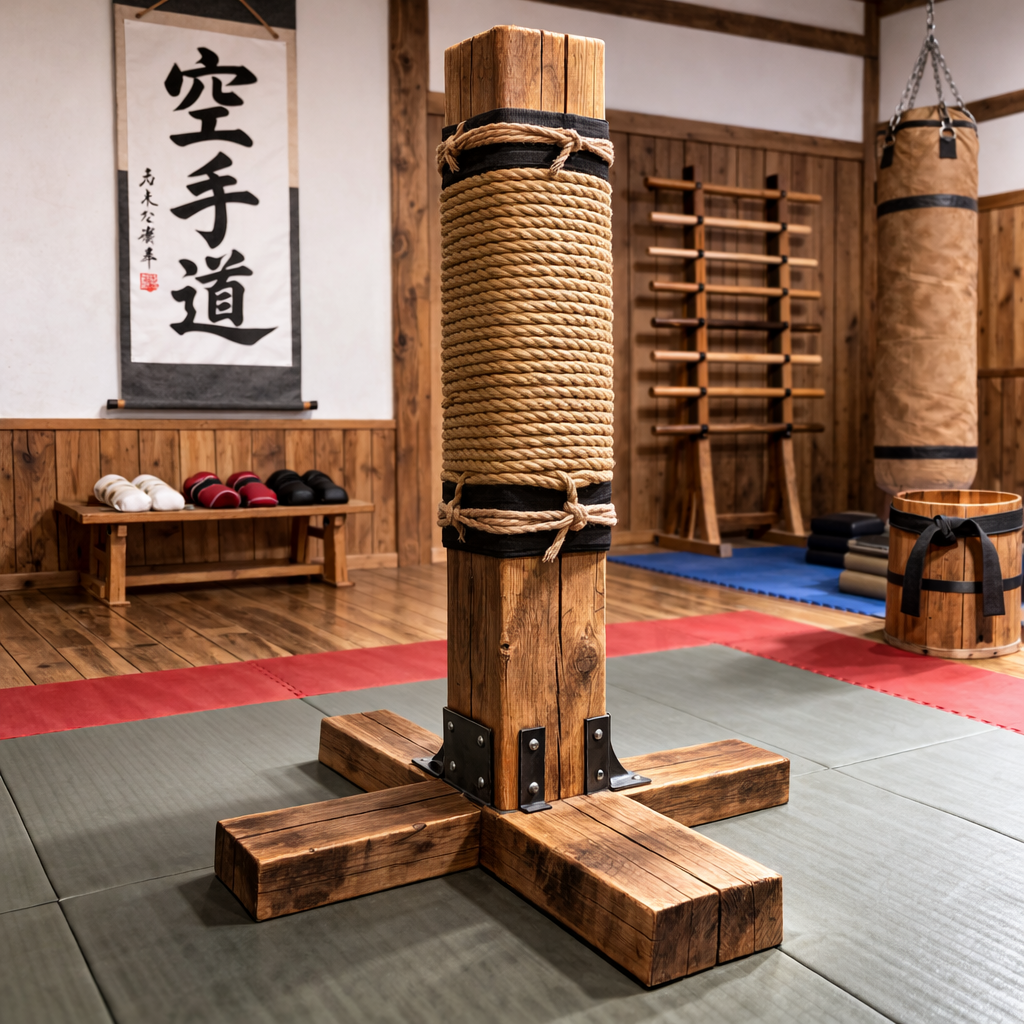
If you enter a dojo of traditional lineage, you will see a wooden post rising from the floor or fixed to the wall, with the top covered by straw rope or a leather pad. This is the Makiwara. In an era of high-tech equipment and gel protections, the Makiwara remains a symbol of resistance and simplicity.
The goal of the Makiwara is not to "callous the hands" in a brute or senseless way, but to teach the karate-ka the biomechanics of efficiency. Have you ever felt that your punch is fast in the air, but "shshakes" or loses form when it hits something solid? The Makiwara is the instrument that corrects this, turning your body into a solid unit at the moment of impact.
The Science of Feedback: The Post That "Speaks"
Unlike a heavy bag, which is weighted and swings, the Makiwara is flexible and offers progressive resistance. The deeper you strike, the more the wood pushes back.
Bone Alignment: If your wrist is slightly bent or your elbow is out of position, the wood’s resistance will make you feel the error instantly. The Makiwara does not forgive faulty alignment.
Real Kime: Because the wood is rigid, you cannot simply "push." You need explosion and immediate muscle contraction (Kime) for the strike to be efficient without hurting your joints.
Connection to the Ground: When hitting the Makiwara, you realize that the force does not come from the arm, but from the pressure of your heel against the floor, transmitted through the hip.
Did you know that the Makiwara teaches the practitioner to "drive through" the target rather than just touching the surface?
Developing the "Martial Body"
Regular training on the Makiwara causes physiological adaptations that go beyond technique. Through years of correct and progressive practice, there is a strengthening of bone density in the knuckles (Kento) and a stabilization of the wrist and shoulder tendons.
However, the wooden master teaches something even deeper: patience. You cannot hit with full force on the first day. It is a process of years of micro-adjustments. Have you ever considered that your ability to persist in repetitive and sometimes uncomfortable training is what builds the mental resilience of a true black belt?
The Makiwara in the Modern World
Today, many dojos have abandoned the Makiwara due to fear of injury or a preference for point-competition training. However, for those seeking Karate as an art of self-defense, it remains essential. Without the test of real impact, the practitioner may develop a false sense of security regarding the effectiveness of their strikes.
Did you know that many ancient masters said that "a day without Makiwara is a day without progress"? To them, the wooden post was the mirror that revealed whether the technique was becoming empty or remained charged with intent and real strength.
Contact
contato@haikaratedo.com