Karate Weapons: How the Practitioner Transforms the Body into an Arsenal
Explore the primary natural weapons of Karate. From Seiken to Empi, discover the anatomy of striking points, how to condition them, and the science behind choosing the right tool for each target.


For the casual observer, Karate is summed up by punches and kicks. However, for the practitioner of traditional lineage, the body is a collection of specialized tools. The concept of "transforming the body into a weapon" is not just a catchy phrase; it is a profound biomechanical study on how to utilize reduced bony surfaces to maximize pressure and penetration into vital points.
Mastering Karate's diverse "weapons" allows the karate-ka to adapt to any combat distance. If a punch is unfeasible due to lack of space, an elbow solves it; if the target is small and protected, the fingertips become a spear. Have you ever stopped to think that Karate's effectiveness comes not from brute force, but from choosing the correct tool for the "geometry" of the moment?
Hand Weapons: The Science of Concentrated Impact
The human hand possesses 27 bones, and Karate utilizes almost all of them. The choice of weapon depends on the hardness of the target and the depth required for the strike.
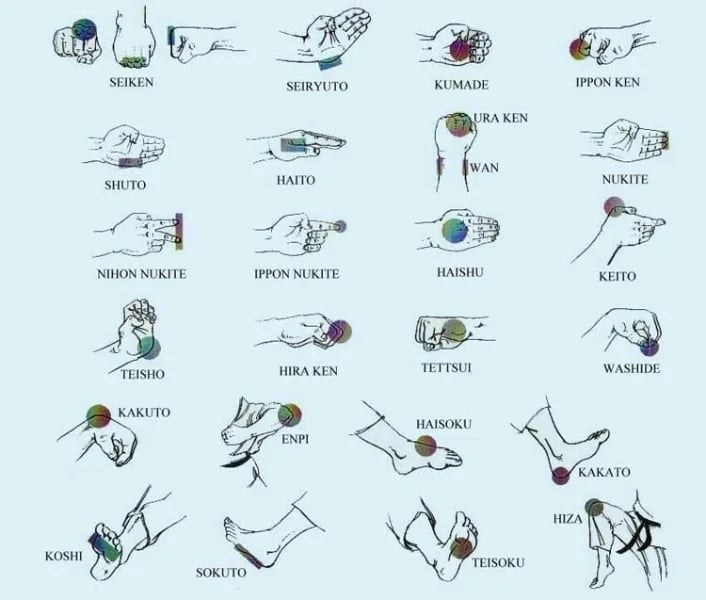
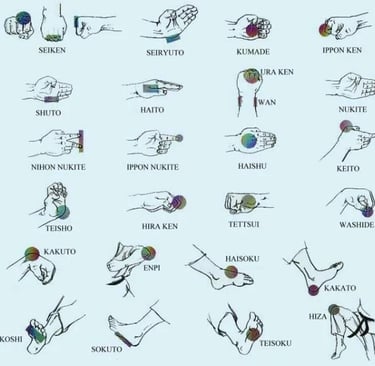
1. Seiken (Forefist)
This is the most classic weapon. The impact must occur exclusively on the Kento (the knuckles of the index and middle fingers).
The Biomechanics: By focusing on these two points, the exerted pressure increases drastically compared to a whole-hand punch. Did you know aligning the Kento with the forearm bones creates a rigid column that prevents your wrist from spraining upon impact?
2. Shuto (Knife-Hand)
As discussed previously, the edge of the hand is used to "cut." It is ideal for striking soft areas like the neck or collarbones. Its advantage is a slightly longer reach than a punch and the ability to be used for both attack and simultaneous defense.
3. Nukite (Spear-Hand)
Here, the fingertips are joined and tensed. Nukite focuses the full force of the arm into an area of just a few square millimeters.
The Target: It is used exclusively on soft parts of the body, such as the solar plexus or the throat. Did you know Nukite training requires rigorous conditioning to prevent the fingers from breaking? In traditional Karate, this is a weapon of surgical precision.
4. Uraken (Backfist)
Unlike a direct punch, Uraken utilizes a whipping motion from the elbow. It is fast, unpredictable, and excellent for striking the face or temples in close-quarters combat.
Upper and Lower Limb Weapons
When the distance closes or when the target requires a greater impact mass, the karate-ka resorts to heavier structures of the body.
5. Empi (Elbow)
The elbow is perhaps Karate's most destructive weapon at close range. Being a short, fixed bone near the shoulder, it does not suffer the energy dissipation that a fist might.
The Structure: An elbow strike (Empi-Uchi) carries the full mass of your torso behind it. Did you know that because it does not involve the small joints of the fingers, the elbow can be used with maximum force without risk of injury to the striker?
6. Koshi (Ball of the Foot)
When kicking (as in Mae-Geri), the karate-ka does not strike with a "flat" foot. They tense the toes back and strike with the ball of the foot. This concentrates the leg's force into a small area, allowing the kick to penetrate between the ribs or strike internal organs.
7. Haisoku (Instep)
Used primarily in roundhouse kicks (Mawashi-Geri), it focuses on speed and reach. It is a whipping weapon, ideal for striking the head or the side of the torso.
8. Hiza (Knee)
The knee is to the legs what the elbow is to the arms. It is a heavy-mass weapon used to destroy an opponent's base or strike the torso in clinch situations.
The Principle of Efficiency: Hardness vs. Softness
A golden rule in Karate is: "Strike a soft target with a hard weapon, and a hard target with a soft weapon."
If the target is the skull (hard), the karate-ka might use the palm of the hand (Teisho) to avoid breaking their own fingers.
If the target is the solar plexus (soft), the fist or fingertips are used for maximum penetration.
Have you ever realized how awareness of these different body parts changes your perception of fighting? Did you know Kihon (fundamentals) training serves precisely to automate the choice of these weapons so that in a dangerous situation, you don't have to "think" about what to use?
Fist Variations (Ken)
Beyond the standard forefist punch (Seiken), the fist can be shaped to penetrate cavities or strike bony areas:
Ippon Ken: The knuckle of the index finger is projected forward. It is a weapon of extreme penetration, used to strike the space between ribs or the point between the eyes.
Hira Ken: The fist is closed only at the second joint of the fingers. This creates a flat but hard surface, ideal for striking the throat or upper lip.
Tettsui (Iron Hammer): Utilizes the base of the closed fist. Like a real hammer, it is devastating for breaking small bones or striking the top of the head.
Kumade (Bear Hand): The palm is open with fingers flexed like claws. It is a massive impact weapon, excellent for striking the ears or face, causing disorientation.
The Evolution of the Spear-Hand (Nukite)
Nukite is not just with four fingers. Depending on the target, we adjust the "spear":
Nihon Nukite: Two fingers in a "V" shape, specifically directed at an attacker's eyes.
Ippon Nukite: A single focused finger. It is a technique of maximum precision for nerve pressure points.
Washide (Eagle Hand): The tips of all fingers come together. It is used to "peck" sensitive areas like the throat or armpits.
Wrist and Hand Edge Weapons
We often forget that the wrist is one of the most solid parts of the arm when flexed:
Teisho (Palm Heel): One of the safest weapons for the practitioner, as it avoids breaking fingers when striking hard targets like the chin.
Kakuto (Bent Wrist): The wrist is flexed downward, striking with the top bony curve. Very common in defenses that transform into immediate attacks to the jaw.
Seiryuto (Ox-Jaw Hand): Utilizes the base of the hand's "blade," near the wrist. It is a heavy impact weapon, ideal for blocking leg attacks or striking the collarbone.
Keito (Chicken Head Wrist): The base of the thumb is used as the impact point. A close-range weapon for striking vital points on the face.
The Arsenal of Feet and Legs (Ashiwaza)
The foot is even more versatile than the hand for generating raw power:
Sokuto (Foot Sword): The outer edge of the foot. It is the primary weapon for side kicks, capable of breaking knees or striking ribs with full body weight.
Teisoku (Sole of the Foot): Used to "stamp" or push the opponent, or to deflect front kicks.
Kakato (Heel): The foot's heaviest weapon. A heel strike descending upon a target is one of Karate's most powerful movements.
Haisa (Back of the Foot/Haisoku): Used to strike the groin or face in quick upward kicks.
The Importance of Conditioning and Precision
Why so many variations? Because traditional Karate is an art of survival. If you injure your fist in combat, you must know how to use your elbow (Empi), palm, or wrist.
Did you know training these less common weapons drastically increases your spatial awareness? When you learn the Haito (ridge hand), you begin to perceive angles of attack that were previously invisible. Have you ever tried to visualize applying a Nukite to a real target and felt how precise your alignment must be not to injure your own fingers?
Contact
contato@haikaratedo.com