
Age-Uke: Much More Than Just Blocking a Punch?
Understand the technique and real-world applications of Age-Uke in Karate. Discover how this rising defense uses angles and rotation to deflect attacks and create openings.
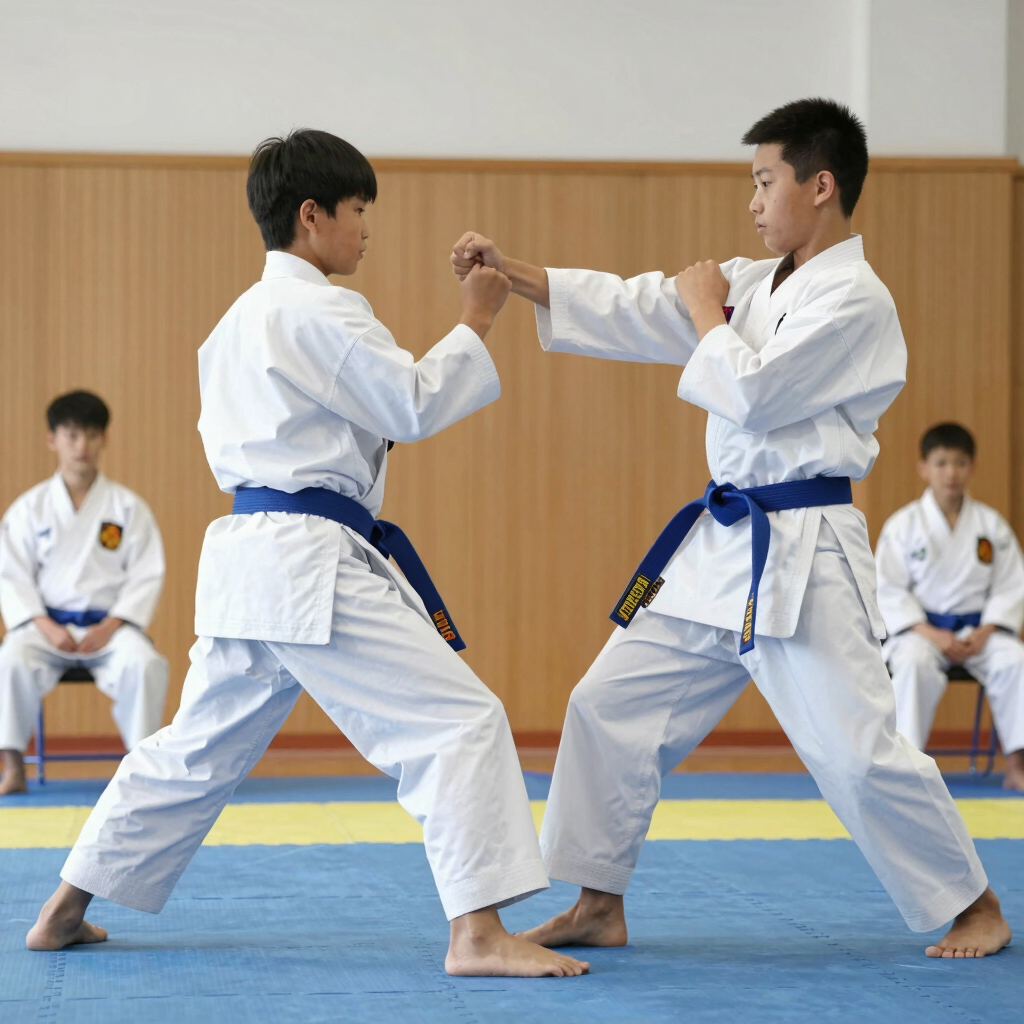
If you observe a beginner performing Age-Uke, you will see a movement that looks like simply raising the arm to intercept a strike. However, if Karate were based solely on "clashing one arm against another," the strongest practitioner would always win. The secret of traditional Age-Uke is not direct shock, but deflection.
Instead of trying to stop a punch like a concrete wall, Age-Uke works like a ramp. It redirects the attacker's energy upward and outward, leaving them vulnerable. Have you ever felt the difference between trying to hold a weight and simply pushing it to the side? Age-Uke is the science of making the opponent's attack "slide" off your forearm.
The Geometry of Defense: Angle and Rotation
For Age-Uke to be efficient against a stronger opponent, three technical elements are crucial:
The Forearm Angle: The arm should not be parallel to the ground but tilted. This inclination allows the opponent's strike to be deflected upward. If your arm is flat, you absorb the full impact in the bone; if it is angled, the opponent's punch loses its trajectory.
Wrist Rotation: Just like in the punch (Tsuki), the defending arm performs a 180-degree rotation at the last instant. This rotation "expels" the opponent's arm from your center line.
Distance from the Forehead: The arm should finish about a hand's width in front of and above the forehead. If it is too close, you could be hit by your own arm upon impact; if it is too far, you lose the shoulder's leverage.
Did you know that the final position of Age-Uke should form a sort of protective triangle? This geometric structure is one of the most stable forms in nature, allowing you to withstand an impact load much greater than your muscular strength alone would suggest.
Bunkai: Hidden Applications of Age-Uke
In traditional Karate, every defense is also a strike or a control technique. When we explore Bunkai (practical application), Age-Uke reveals surprising facets:
Vital Point Strike: The rising forearm can be used to strike the opponent's chin or throat at close range.
Posture Breaking: By defending upward, you can "lift" the opponent's center of gravity, leaving them unbalanced and ready to be thrown or struck.
Grab Release: The circular and upward movement of Age-Uke is extremely effective for breaking a grip on your wrist or collar.
Synchrony with the Hip and Hikite
As in all Shotokan techniques, Age-Uke is not born in the shoulder but in the hip. Rotating the Koshi to the Hanmi (half-open) position at the moment of defense provides the necessary strength to withstand the impact.
Simultaneously, the opposite arm performs a vigorous Hikite to the waist. This "pull and push" action stabilizes the torso and ensures you don't over-rotate, keeping you in control of the situation.
Contact
contato@haikaratedo.com